HTML4/XHTML vs HTML5: Key Differences and Benefits
Written By: Avinash Malhotra
Updated on
HTML4 and HTML5 are both markup languages used for creating web pages, but HTML5 is the latest standard with significant improvements. HTML5 introduces semantic elements, better multimedia support, and enhanced accessibility, making it essential for modern web development. While HTML5 retains many elements from HTML4, it removes outdated presentational tags and emphasizes the use of CSS for styling. This guide compares HTML4 and HTML5, highlights the benefits of upgrading, and explains how to ensure compatibility with older browsers.
HTML4 vs HTML5: A Detailed Comparison
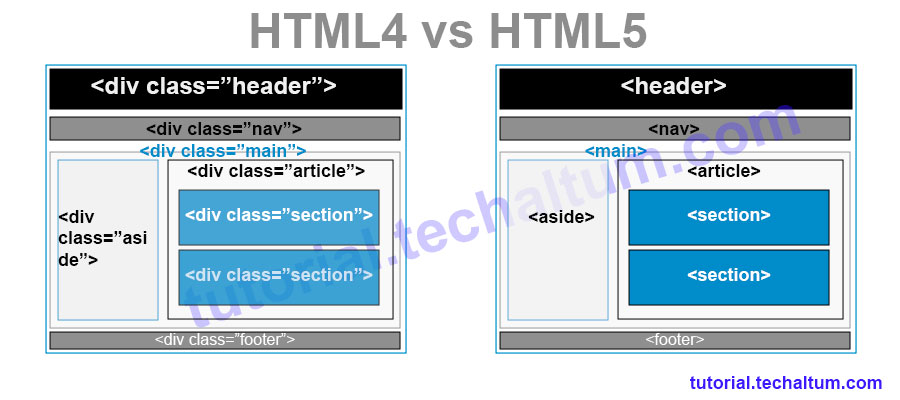
HTML5 offers more semantic meaning compared to HTML4. HTML5 introduces semantic elements such as header, nav, article, aside, section, figure, and footer, whereas HTML4 relied heavily on generic div tags for structure. Let's explore a detailed comparison between HTML4 and HTML5.
Key Differences Between HTML4 and HTML5
| Feature | HTML4/XHTML | HTML5 |
|---|---|---|
| Semantic Elements | Generic div tags | Header, nav, article, aside, section, figure, footer |
| Multimedia Support | Requires plugins (Flash, Silverlight) | Built-in audio and video elements |
| Form Elements | Basic input types | Enhanced input types (email, date, color) |
| Canvas and SVG | Not supported | Supports canvas and SVG for graphics |
| Browser Compatibility | Supported by all browsers, but limited features | Supported by modern browsers, with polyfills for older versions |
| Offline Storage | Not available | Local storage and session storage available |
| Mobile Optimization | Limited support for mobile devices | Designed for mobile-first development |
With HTML5, websites become more semantic for both users and search engines. Search engines favor HTML5-based websites because they can better understand the structure and content hierarchy. This leads to improved SEO rankings, as crawlers can easily identify headers, main content, navigation, and footers. Upgrading to HTML5 not only enhances user experience but also boosts visibility in search results.
Ensuring Compatibility with Internet Explorer 8 and Older Browsers
HTML5 became a web standard in 2009, but Internet Explorer 8 and earlier versions do not support the new elements and attributes. To ensure compatibility, you can use conditional comments to add support for these browsers. Below is an example of how to implement this in the head section of your HTML document.
<!doctype html>
<html>
<head>
    <meta charset="utf-8">
    <title>HTML5 Page</title>

<!--this condition is only for IE 8 and lesser browsers.-->

<!--[if lte IE 8]>
        /*lte means LESS THAN & EQUAL TO IE8*/
<script>
document.createElement('header');
document.createElement('nav');
document.createElement('main');
document.createElement('article');
document.createElement('section');
document.createElement('aside');
document.createElement('footer');
document.createElement('mark');
</script>

<style>
header, nav, main, article, section, aside, footer{
    display:block;
}
mark{ background:#ff0; color:#000;}
</style>

<![endif]-->

<style>
*{margin:0; box-sizing:border-box}
.container{ max-width:1200px; margin:auto}
main{ display:flex;}
article{ flex: 1 0 75%; }
aside{ flex: 1 0 25%}
</style>
</head>

<body>
<div class="container">
    <header>
        //This is Header of Webpage
    </header>
    <nav>
        //navigation Menu will Come Here
    </nav>
    <main>
    <article>
        //Content for article with heading
        <section>
        	// section of article with heading
        </section>
    </article>
    <aside>
        //Right part of website
    </aside>
    </main>
    <footer>
        //footer of the webpage
    </footer>
</div>
</body>
</html>
Using HTML5Shiv for Cross-Browser Compatibility
HTML5Shiv.js is a JavaScript library that enables HTML5 semantic elements in older browsers, particularly Internet Explorer versions 8 and below. By default, modern browsers like IE9+, Chrome, Firefox, and Safari support HTML5 tags, but older versions require this shim. Always include HTML5Shiv within conditional comments to target only outdated browsers, which also helps maintain better page performance.
You can download HTML5Shiv or use it directly from a CDN. Click the buttons below to view or download the file.
View HTML5shiv Download HTML5shivHow to use HTML5shiv
<!doctype html>
<html>
<head>
    <meta charset="utf-8">
    <title>HTML5 Page</title>

<!--[if lte IE 8]>
<script src="js/html5shiv.js"></script>
<![endif]-->

<style>
*{margin:0; box-sizing:border-box}
.container{ max-width:1200px; margin:auto}
main{ display:flex;}
article{ flex: 1 1 75%; }
aside{ flex: 1 1 25%}
</style>
</head>

<body>
    <div class="wrap">
        <header>
            //This is Header of Webpage
        </header>
        <nav>
    		//navigation Menu will Come Here
        </nav>
        <article>
    		//Content for article
            <section>
            	//A Particular section of article
            </section>
        </article>
        <aside>
            //Right part of website
        </aside>
        <div class="clear"></div>
        <footer>
            //footer of the webpage
        </footer>
    </div>
</body>
</html>
HTML5shiv CDN
We can also used HTML5 cdn. Here is the code
<!--[if lte IE 8]>

<script src="https://cdnjs.cloudflare.com/ajax/libs/html5shiv/3.7.3/html5shiv.min.js"></script>

<![endif]-->
Note: By implementing these techniques, your website will fully support HTML5 semantic elements across all browsers, ensuring a consistent user experience.